Showing posts with label Articles and Reports. Show all posts

Sunday, July 31, 2011

NATIONALITY – HERO WORSHIPING V/s. Humanity in the Human Pageant:

NATIONALITY – HERO WORSHIPING V/s. Humanity in the Human Pageant:

Often I have felt that the purpose of writing these posts is to help myself remember the truth of life and its virtues that I so often forget. There are so many great men and women born on this earth. Many are now worshiped as god. Take for example Ram or Krishna or Buddha or Christ for example. These were just mortal men like us. But they are worshiped because of beautiful thought provoking messages they have conveyed.

One problem with worshipping is glory and that magnificent light that surrounds these men of substance. Light and glory are good. But the side effect is blurring of the message that these men of substance sought to convey. So here is an idol we have. The idol is beautiful. It is serene and we must enjoy worshiping the idol. But in the meanwhile, the message that the man Krishna or Ram or Buddha or Christ wanted to give gets lost. Then remains the form; a form so thoughtless, so empty. There are hundreds of Bhaktas – the devotees. These devotees pile up and line up. These devotees are full of e motions. They are full of Bhakti. But the thoughts are lost. The message is lost. So we have devotees of lot of religion and dharmas doing things exactly opposite to what their heroes taught them to do. For example Jains practice fasting. Fasting perhaps may have a purpose of “Atma Suddhi”. The cleansing of soul. But then that should entail with it lot of forgiveness and mental peace. But that is not the case. Fast then become a ritual. Fasting now is a religious ceremony. It is performed without any intention of “Atma Suddhi”. The thoughts do not change. Thoughts remain self-same. There is so much of disgruntled feeling. And fasting adds to that irritability. The purpose is lost. Religion survives. God dies.

When I was in school – long back, we were taught songs of Patriotism. It was a feeling of India V/s. World. We were taught of the long standing freedom struggle that we have undertaken as a nation. There were men and women of substance who laid their lives for us. We sang songs about Gandhi, Bhagat Singh and lot of other heroes. There was a feeling of nationality particularly being a grandson of a freedom-fighter who never claimed any pension from government. As age advanced, as knowledge of world, economy, polity increased; these feelings changed.

Slowly but steadily there came a feeling of lack of national oneness. Here was not a nation – but a group of people who were using the emotions of thousands of people. This group of people was shrewd. It was essentially power and money game and nothing more. Post 1991 – in the liberalized economy, I was a strong patron of Narasimha Rao – then Prime Minister. The pathetic government managed institutions justified need of ushering privatization at the national platform. Perhaps basic idea was good governance and honest administration away from corruption. But after 20 years we have a Prime Minister - Dr. Manmohan Singh who looks more like a representative of the US Senate rather then the head of Indian Government. Was Rao no different?

While I write this, I do admit my affiliation and complete inclination towards the Congress Party. But so what? Do I lose my right as an individual to speak out my view? While this is true, I must say and admit that BJP will make no difference if it is in power. Rather they have better potential to make it worst. Whatever, the very idea of national leader sounds redundant? That is false and it cannot be so! Here we have no leader since leadership means unity of purpose. Are we heading towards any purpose? I have serious doubts. It is just a corporate business that we are into. A corporate business!

At the party level, I have felt that there is hero worshiping. We all have leaders. The local leaders have state level affiliations and state leaders have national level affiliations. There is a gang. The purpose of gang is to accumulate power; to get into positions by using all means. This is just not true for one political party but true across the board.

Same is the case with personal lives of people. Here we have heroes like Ram or Krishna. More then these heroes we have agents who proclaim peace and prosperity in our lives. These agents claim to know God. They claim to have ability to help us go closer to God. I do not know about people or the devotees, but the god-men or heads of religious institution definitely improve their quality of life. They get into better bargaining powers with the government and with everybody around them. They muster wealth beyond imagination and live luxuries that are unknown to most of those living on this earth. All this goes on in the name of God. Poor God! He has permitting these God men to rule us in His name. And now God must wait for all the communities to get sufficiently aware so to thwart these religious leaders from doing further loss. And what a fine business is religion. In India all income by religious institution is tax free. Does not this sound like a great business? Well – it is.

I was reading Einstein’s Book – “The world as I see it”. Although the original version where he may have written relativity is beyond my intellectual comprehension which I must admit, but there are sections that are just great.

These sections reflect what a man of depth Einstein must have been. On his ideas of patriotism, Einstein writes and I quote from his book:

“…This topic brings me to that worst outcrop of the herd nature, the military system, which I abhor. That a man can take pleasure in marching in formation to the strains of a band is enough to make me despise him. He has only been given his big brain by mistake; a backbone was all he needed. This plague-spot of civilization ought to be abolished with all possible speed.

Heroism by order, senseless violence, and all the pestilent nonsense that does by the name of patriotism--how I hate them! War seems to me a mean, contemptible thing: I would rather be hacked in pieces than take part in such an abominable business. And yet so high, in spite of everything, is my opinion of the human race that I believe this bogey would have disappeared long ago, had the sound sense of the nations not been systematically corrupted by commercial and political interests acting through the schools and the Press…”

Wednesday, July 20, 2011

EXPERIENCE WITH BHART SANCHAR NIGAM LIMITED – THE TALE OF INDIAN BUREAUCRACY:

Many a times little incidences teach us a lot. These incidences are little because of the Value attached to them. Value could be financial value or value in terms of importance in daily life.

We live in India that harps of magnificent progress. Our country is amazing. Its political leaders foresee India as a global super power when in fact we have millions of our brothers in villages starving and hundreds of farmers committing suicide. However, with a section of our people in India, talking adversely about our country is a sin. So taking that sin in my account of life, I am narrating one experience that I recently had with telephone department of our nation. The BSNL – although now autonomous is not private. It happens to be part of the government organizations in India.

With on set of monsoons many of those who live in India or have lived in India know that phones go dead. One such incidence happened with one of our land line numbers.

So how do you get the line to work back? Call up the complaint division. Some technician comes from the company; repairs the phone. Is it over?

No. BSNL does not work that way.

The BSNL phone line was completely dead – it did not function. Routine complaint number for BSNL is 198. Years back when machines were not in vogue, people – I mean human beings used to pick up 198. So you could call up the complaint number and speak to the individual on the other side. With greater technology, greater problems have visited BSNL. The leaders of BSNL have replaced human operator with machine operator. Calling 198 now is a nightmare. The machine first of all picks up the phone and it gives you multiple options of languages that you may want to choose from. Once the redundant exercise is over, it simple gives you hell lot of options regarding your complaint. This way the roller coaster ride begins and the consumer is asked to dial the area code and then the phone number and such stuff. By the end of it, when you are looking forward for receiving your complaint number the machine hangs the phone in between. If you try again, same thing happens. Try again – no difference.

So our people tried the complaint number and all bombed. There was nobody to register the complaint. Somehow our old diaries have had some alternative complaint numbers. So we tried those numbers. Those numbers too were not available. They were busy. We assigned the Herculean task of lodging the complaint to one of us who was trying to get the complaint numbers. But the numbers were busy for as long as 10 hours.

Since we did not find access to complaint numbers, we called up another number that belonged to the supervisor. When the supervisor was called, he refused to accept that the BSNL numbers could be dysfunctional. Well – we did not have hobby of passing time. May be supervisors did not understand this. The supervisor somehow said that try the number again and you will get it. He sounded confident. After 5-10 minutes, the complaint phone number (alternative number) was available with the operator on line! Oh! Great. At least we heard a human voice from the complaint resolution department (I don’t know if they have such a department at all). We felt that supervisor had a switch and once the switch was pressed on – the complaint receiving phone number started accepting phones. The complaint was lodged. A complaint number was given. We thought that the matter would get settled and solved within a day. Next day a line man (guy who repairs phone lines) came. He examined the lines. He said the line is okay but there was some water in the wall socket that was causing the problem. He had cleaned the water. His assurance that “the matter will get solved” turned wrong. Next day the phone was not working. Once again another complaint was lodged. The line man came next and this time he identified fault with a devise called “splitter”. He said the splitter needs to be changed. We said okay – do it. The line man smiled and said BSNL does not supply splitters. So it’s like going to barber and the barber says go and get scissors from market and I will cut your hair. From our office, phone was made to the immediate supervisor of lineman. They call it Junior Telephone Officer. That guy happily informed that lineman was right. He added that they were honest and he did not want people to accuse him of selling BSNL instruments that were given for free. He felt BSNL was corruption free organization in India. Ultimately we had to send somebody to the market at a place suggested by the BSNL guy to get splitter. Another one day passed and the lineman came to change the splitter. He changed the splitter. The problem still continued. By this time, we had lodged almost about 5-6 complaints with BSNL.

Since the matter did not get resolved once again the line man came and this time, he said that exercise of changing splitter was not necessary but that our internal wiring of phone lines was defective and needed a change. He asked us to change the concealed line wiring. Since the lineman had gone wrong twice, this time we had little reason to believe what he said. Therefore more then a trouble with phone line we felt there was a trouble with his intentions. Therefore, we lodged complaint with the General Manager and the Manager of the City explaining the array of events that had taken place. A copy was marked to our legal section, to take up the matter with court, if needed. The seniors happened to be good. Therefore, they sent the divisional engineer next day to examine and solve the problem. The divisional engineer came and it took 15 minutes to solve the problem that had taken more then 10 days of waiting time, 12-15 complaints and more then 4 calls to the supervisors.

This is a way our bureaucracy functions. Recently a Minister’s wife had lost a purse at the train station containing 40000 INR and some credit cards. Within 7 days the police – cops got the purse back. But there are thousands of mothers whose daughters have got lost to be pushed to brothels. There are thousands of children who get lost and their limbs are cut off so that they can be made to beg on roads. Our police are not able to find them. Our police can hit sticks to mobs, fire tear gas on assembly of people who assemble peacefully, but they cannot fight terrorist or detect bombs. We must seek permission from police to assemble peacefully!!!! What a nation we are building up? Good heavens, there are some like Anna Hazare or Arvind Kejriwal who are born as anomaly in this nation. For rest of us, it is a routine business… who cares?

We feel that we are living in a country whose officers have powers without answerability. Bribe is an rooted culture here. It starts from the first day we visit temple. We give gifts to God to do us favors more then our symbol of love. The culture of bribery comes by birth. I do not know, if we will ever get rid of the spoilage we have created. But the little incidence of BSNL was amusing particularly in case of a phone line that was of little use to us!

Saturday, August 2, 2008

Christian Eckart on Saddam's Trial.

I had been through this paper on Saddam Hussein’s Trial that questions the legitimacy of a trial. It demands perhaps for a fair trial. The author has presented this paper in the LLM studies at the Cornell University. I liked the flow, content and analysis of the paper and that makes me put up this one on this blog. The contents expressed in the paper are those of the author.

The trial no doubt in terms of judicial parlance must be fair according all possible defense to the accused and shifting the burden of proof on the prosecution.

However, is the purpose of trial to adhere to the doctrines of procedure or is the spirit of law and justice prime concern for a trial? Is it right for us to distinguish a trial of an international accused like Saddam Hussein from that of an ordinary crime conducted by an ordinary civilian? To put it the other way: were the acts of Saddam Hussein at par with those of other accused coming to courts everyday?

The answer is left to the readers. I do not wish to embark on that analysis. The ends are equally important as means, if not more. Just juxtapose Saddam with Bush. How would have Saddam behaved with Bush had he been in the position of Bush and Bush standing in the shoes of Saddam – in power terms? That precisely will show the difference between the civilized and brutal, the difference between a democratic ruler and a tyrant. Christian hails from a democratic country and has freedom to take his views. Could a subject of Saddam do this when he ruled?

The purpose of putting this paper is not to endorse the contents or its findings, but to show the professional way in which the analysis has been done so thoroughly.


Saddam Hussein’s Trial in Iraq: Fairness,
Legitimacy & Alternatives, a Legal Analysis
by Christian Eckart


Abstract

The paper focuses on Saddam Hussein’s trial in front of the Iraqi High Criminal
Court in Baghdad. After providing an overview of the facts surrounding the
court’s installation, the applicable international law is identified and the fairness
and legitimacy of the current proceedings are analyzed. The paper finishes by
considering whether the trial should be relocated and addresses alternative venues that could have been chosen to prosecute Iraq’s ex-dictator.

I. INTRODUCTION

With the questioning of Saddam Hussein in front of the Iraqi High Criminal Court on October 19, 2005, a trial began that has been labelled by some as “the trial of the century”. Whether this is true or not, the proceedings in Baghdad receive high publicity and are under close scrutiny by major human rights organisations5, legal experts, and indeed the general public, as the news coverage is extensive. Why does the trial attract so much attention one may wonder and why do so many people care about ensuring fair proceedings for an ex-dictator on trial for major human rights violations, a dictator that himself made extensive use of a special Revolutionary Court guaranteeing fast executions but by no means due process of law.


In answering this question the optimistic legal scholars might first of all point to the fact that – as will be discussed later - international law requires a fair trial and for those who believe in the rule of law, this will indeed be an important reason to turn their eyes towards Baghdad. But there is more to it. The trial held in the fortified “Green Zone” in the middle of Baghdad is special in many ways. First there is the hope that this trial might serve as a model for Iraq and might help to re-establish trust in the judicial system and its protection against the deprivation of rights which has been strongly eroded by the past 23 years of Saddam’s reign and to thereby allow the country a “new start” based on firm legal principles. In order to help Iraq through the very delicate transition phase, shifting away from a violent suppressive dictatorship towards a fragile new democracy, the trial will need to open avenues for reconciliation, provide justice for those whose rights were violated and publicly acknowledge the atrocities that have happened in the past decades.7
Further more by holding Saddam accountable, the current criminal proceedings add yet another name to the list of recent precedents in which heads of state had to face charges for violating international law.8 The trial might thereby serve as another mosaic stone in establishing the rule of law and deter others from stepping over the lines drawn by international agreements and custom in the area of international criminal law.

However, the trial is also being perceived as closely connected to the heavily criticised U.S. led invasion of Iraq that has been claimed by many to infringe international law9 and was founded on assumptions which turned out to be false.10 As the U.S. played a major part in setting up the tribunal, the trial is in danger of at least being perceived as “victor’s justice” and mere show by the world audience, finding guilty a dictator who by many - including high officials such as the Iraqi President Jalal Talabani or the Commander in Chief of the U.S. Army President Bush - has already been declared guilty. To establishing model proceedings in Iraq and avoid mock trial’s the trial needs to be fair. It has been said that in light of Saddam’s past it would be bitterly ironic to transform him into the “poster boy for fair trials and due process,” which might be true. Nevertheless, it is necessary to do so, in order to establish a trustworthy and fair judicial system in Iraq, displaying that any accused, even one considered guilty by so many for the most heinous crimes, will receive a fair trial and be presumed innocent until otherwise proven. There is a lot at risk in Iraq at the moment and the world audience is watching. Whether the proceedings in front of the Iraqi High Criminal Court are fair and legitimate and whether the trial in Baghdad is the soundest solution to achieve the aforementioned objectives is the subject of this paper. In addressing it, the factual background will be provided first, followed by the legal analysis.

II. FACTUAL BACKGROUND

A) THE INVASION OF IRAQ AND THE INSTALLATION OF THE COURT

To be able to asses the legitimacy of the Court’s installation, it is important to keep the timeline of the invasion in mind: A U.S. led coalition began its military action against Iraq on March 19, 2003. Very short after that, on May 1, 2003, the end of major combat operations was declared by U.S. President George W. Bush which was followed by a formal occupation of Iraq. After transferral of the power to the Interim Government on June 28, 2004, the U.S. declared an official end to the occupation on June 30, 2004. Elections on January 30, 2005, resulted in the construction of a Transitional National Assembly, which drafted an Iraqi constitution that was adopted by vote on 15,
October 2005. Elections for an Iraqi government finally took place on December 15, 2005.

The Court was installed during the ongoing occupation of Iraq. Only a few days prior to Saddam’s capture by Coalition Forces on December 13, 2003 the Iraqi Governing Council authorized by, in cooperation with and subject to the approval of the Coalition Provisional Authority (CPA) – the administrative body created by the coalition as the occupying power - promulgated the Statute of the Iraqi Special Tribunal (IST) on December 10, 2003. The Iraqi Governing Council as the promulgating body consisted of Iraqi members handpicked by the CPA.

The U.S. has further been involved through the Department of Defence’s Regime Crimes Liaison Office, which has played a major role in the tribunal’s installation by training judges and prosecutors, building courtrooms, providing resources and personnel for investigations or evidence gathering and by training the court’s staff. The U.S. provided for the tribunal’s funding and spend U.S. $ 75 million dollars19 to install and support it, a sum that has since risen to U.S. $ 128 million. On August 11, 2005, the elected Iraqi Transitional Assembly revoked the original IST Statute and adopted an amended version, which also changed the courts name to Iraqi Higher Criminal Court (IHCC).21
Saddam’s trial finally began in the trial chamber on October 19, 2005 in which all defendants pled non guilty. During that time Baghdad was, and to the present time still is, constantly shaken by terrorist attacks which have not halted before the court room doors. Only a day into the trial, on October 20, 2005, one of the defence lawyers for Awad Hamed al-Bander, former chief justice of the Iraqi Revolutionary Court who is also on trial before the court, was kidnapped by a group of armed men and found shot dead later the same day. A few weeks later on Nov. 8, 2005 two other lawyers representing Saddam’s co defendants were attacked, one of them killed, the other one seriously wounded. This attack brought the number of killings associated with the court up to 8,
including one of its judges.

While the U.S. occupation has long ended and the sovereignty is back in the hands of the Iraqi people, U.S. forces, staff, and infrastructure are still desperately needed to ensure a minimum of security and stability in the country. Coalition troops are still present in large numbers in Iraq and they are struggling against a strong insurgency that has already killed more U.S. soldiers than the actual combat operations ever did. Sectarian violence has increased dramatically over the last months and has since then cost hundreds of lives. Many believe that Iraq is either on the verge of a civil war or already in it.

B. THE COURT’S JURISDICTION, STRUCTURE & STATUTORY

PROVISIONS

The erected court is not part of the regular judiciary system of Iraq. The Court has jurisdiction over Iraqis as well as non-Iraqi residents in Iraq accused of genocide, crimes against humanity and war crimes committed in the territory of Iraq or elsewhere since July 17, 1968 up until May 1, 2003, the date on which the formal occupation of Iraq began. In addition to these three crimes which are also enlisted in the statutes of the International Criminal Tribunal for Yugoslavia (ICTY), the International Criminal Tribunal for Rwanda (ICTR) and the International Criminal Court (ICC), the
Iraqi statute ads three further crimes derived out of and with reference to Iraqi law. These are described as the “Intervention in the judiciary or the attempt to influence the functions of the judiciary”, “the wastage and squander of national resources” as well as “the abuse of position and the pursuit of policies that may lead to the threat of war or the use of the armed forces of Iraq against an Arab country”.

The statute declares Iraqi Criminal Procedure Law for applicable31 and therefore relies on inquisitory criminal proceeding as known in a lot of civil law countries, placing more power and responsibility on the judge compared to the typical common law adversary system. The trial is preceded by an investigation performed by an investigative Judge, who also has the power to question suspects, witnesses and victims in order to gather evidence. If the Investigative Judge finds a prima facie case as being established, the Judge will prepare an indictment and refer the case to the (trial) court.

The trial chamber of the IHCC consists of five,34 the appeals chamber provided by the statute of nine judges. The Statute requires judges, members of the prosecution committee as well as the court’s staff36 and the principal defence lawyer of the accused37 to be Iraqi nationals. Non-Iraqis may at the discretion of the court be approved as advisors to the court38, a non Iraqi judge may however sit in case a State is one of the parties and this is deemed necessary.39 No Non-Iraqi judge is currently sitting on the case before the court. The court is therefore a truly national court, not an international one as the ICTR, the ICTY or the ICC or what is referred to as a “hybrid court”, such as the Special Court for Sierra Leone which (being set up in cooperation with the U.N.) is composed of national as well as international judges, the latter being nominated by the Secretary General of the U.N. The penalties that are prescribed by the statute are those of Iraqi law, which does include the death penalty, usually administered by hanging.43 As Iraqi law does not include crimes like genocide, war crimes and crimes against humanity and therefore does not provide for any sentences for perpetrators of these crimes, the Statute refers to the sentencing for the crimes of murder and rape which are prohibited under Iraqi law. These might be included in one of the crimes punishable under the Statute such as genocide. A premeditated killing or a killing as a result of the use of toxic substances or explosives is for example punishable by death under Iraqi law45 and the death penalty might consequently be imposed if these acts were committed by the accused as part of a war crime, genocide or crime against humanity. If the crime lacks any counterpart under Iraqi law the Court has to determine the punishment taking into account factors such as the gravity of the crime and individual circumstances.

The trial is televised and broadcasted around the world with a twenty minute delay to allow censoring and avoid unforeseen events. Saddam originally had the right to represent himself (like Milosevic had) but according to the revised statute he now merely has got the right to “use a lawyer of his own choosing.” As the other accused Saddam is represented by legal counsel of his choice in front of the court. As required by the statute his main defense counsel is Iraqi but he has a defense team comprised of international jurists, amongst them former U.S. attorney general Ramsey Clark,whose involvement has spurred quite some publicity.

C) THE CASE CURRENTLY BEFORE THE COURT

While Saddam is on trial in Iraq at the time of writing, he is not indicted for the major crimes he allegedly committed. Besides the ongoing torture and killing of dissidents, these would especially include the Anfal campaign (gassing of Iraqi Kurds – killing 50.000 - 100.000 including the gassing of the village of Halabja, killing 5000 civilians), the 1991 massacre after a Kurdish Shiite uprising, which was encouraged by the coalition forces pulling out of Iraq at the time, the assault on the Marsh Arabs (including the bombardment of villages, the employment of torture and disappearances, displacing at least 100.000), the waging of war against Iran employing chemical weapons and the invasion of Kuwait in 1990.

Instead Saddam is being tried for the alleged reprisals after a failed assassination attempt against him. The incident took place in 1982 in the town of al-Dujail and supposedly led to summary executions, lengthy imprisonments and show trials with finally 148 people dead. 96 were hanged in Abu Ghraib prison and 46 died under torture, including four additional inmates who were accidentally added to the group. According to the Iraqi Tribunal this incident was chosen as it is very well documented and a relatively clear and simple case. The prosecution introduced evidence directly linking Saddam to the executions, including a document which supposedly carried his signature, signing off the alleged Dujail perpetrators to be executed. It is however not clear with which crimes within the court’s jurisdiction Saddam has actually been charged as the indictments have not been made available to the public. Looking at the statute it is likely that the killing of 148 men and boys might constitute a crime against humanity within the courts jurisdiction (Art 12 IHCC Statute), being “wilful murder” as part of a “widespread” but more likely “systematic attack” directed against the civilian population.

Despite the argument that the Dujail case might be easy to prove, the decision to start the proceedings with this case is problematic. The IHCC Statute requires the punishment issued by the Court to be executed within 30 days of the date when the judgement becomes final. If Saddam was sentenced to death this would mean that he might never be put on trial for many of the most gruesome crimes he allegedly committed which would jeopardize the high hopes that accommodate the trial in terms of the country’s reconciliation. The injustice done to many victims by Saddam’s regime needs to be addressed by the criminal proceedings. Although it will hardly be possible to indict Saddam for every single criminal act, e.g. every torture or disappearance allegedly committed, major crimes amounting to crimes against humanity or genocide as punishable by the IHCC should be addressed before the court. It is doubtful to say the least that sentencing Sad dam for the killings in Dujail would sooth the wounds of those who lost relatives and friends in the Anfal campaign. The pragmatic approach that the case of Dujail is supposed to be easier to prove and well documented is unlikely to be accepted by many victims. However, the court might try to find a way around the execution deadline found in Art. 27.2 and has indeed said that it plans up to 12 trials for Saddam. He has now been officially indicted for genocide, crimes against humanity and war crimes committed in an internal conflict for the Anfal campaign but it is still un clear when the proceedings in this case are going to start.

To avoid Saddam’s execution to be carried out the court might for example declare an execution incompatible with an ongoing proceeding in another case before the court and interpret the provision in a way that the punishment must be executed within 30 days after a judgement has been issued and no other proceedings are pending. However this is an exception not provided for by the language of the statute and it might be criticised as arbitrary and not founded in law. It should be noted that such an interpretation of the statute would also lead to a situation in which an accused sentenced to death has to wait for his penalty for what is likely to be several years during ongoing criminal proceedings. With regards to the extreme psychological stress for the convicted and the so called “death row phenomenon” this might amount to “cruel and inhumane treatment” and has for example been declared incompatible with the European Human Rights Convention.

The Human Rights Committee as the body responsible for interpreting the International Covenant on Civil and Political rights (ICCPR), which is applicable to Iraq, has however declined to interpret the parallel provision in the ICCPR forbidding cruel and inhuman treatment in the same way. The Committee did not want to lay pressure on states to encourage (speedy) executions. This dilemma – taking the ECHR point of view that long imprisonment on death row might amount to cruel and inhumane treatment - would best be solved by excluding the death penalty from the penalties that might be imposed by the court. Although the death penalty is not prohibited by the ICCPR there are strong international tendencies in outlawing it and it is banned from the Statutes of the ICTY, ICTR and the ICC.

Along with Saddam seven more people are accused for their alleged involvement in the case, amongst them are Taha Jassin Ramadan64, Iraq’s former Vice-President, Barsan Ibrahim al-Tikriti, who is a younger half brother Saddam’s and former director of general intelligence (Mukhabarat) as well as Awad Hamed al-Bander, former chief justice of the Iraqi Revolutionary Court.

III. LEGAL ANALYSIS

A) THE COURT ‘S LEGITIMACY

There are several legal treaties and norms applicable to the installation of the court as well as to the proceedings in front of it. During the war and especially the time of occupation, in which the original IST statute was promulgated and the tribunal was installed, the Geneva Conventions and the Hague Convention67 applied. The U.S. as well as Great Britain are parties to the Conventions. The Geneva Convention Relative to the Protection of Civilian Persons in Time of War (commonly referred to as IV. Geneva Convention) includes several provisions governing the powers of an occupying power.

Among these is Article 64 which provides that subject to security threats “… and the necessity for ensuring the effective administration of justice, the tribunals of
the occupied territory shall continue to function in respect of all offences covered by said
laws.”

Art. 43 of the Hague Regulations compels the occupying power to ensure public order and safety and to respect the laws in force in the country, unless absolutely prevented.

It has been argued both for and against the legality of the installation of the tribunal based on these provisions. It is clear that the court is a tribunal which was newly created under the control of the Coalition Provisional Authority and it does not belong to the regular Iraqi legal system. The defence further more raises the argument that the occupation was illegal under international law and therefore the installation of the tribunal must also be illegal as it was set up through an official act during the occupation.

Defending the Court’s installation it has for example been claimed that the tribunal was necessary as a measure to “restore, and ensure, as far as possible, public order and safety” as provided by Art. 42 of the Hague Regulations just as the Security Council used its obligation to “maintain or restore international peace and security” to create the ICTR and ICTY under its Chapter VII UNC powers.

Notwithstanding this dispute the current tribunal receives strong legitimacy through the fact that its statute has subsequently been amended and approved by the Iraqi Transitional Assembly. The court is also expressly mentioned and empowered by the Iraqi Constitution.73 Adopted on October 15, 2005, its Article 130 reads as follows “The Iraq High Criminal Court shall continue its duties as an independent judicial body,in examining the crimes of the defunct dictatorial regime and its symbols. The Council of Representatives shall have the right to dissolve by law the Iraqi High Criminal Court after the completion of its work.”

There might still be doubts whether the Iraqis really had the free choice to abandon the court had they wanted to do so. After all, it had been set up, financed and provided with a full legal framework and the proceedings had already started. Furthermore the support in troops and the infrastructural help Iraq receives by the U.S. is substantive and vital for the country.

Nevertheless the court has been approved by the Iraqi people through a direct vote in adopting the constitution as well as through the Transitional Assembly, a body elected by the Iraqi people, when it amended the Court’ s Statute.

B) JURISDICTION, NULLUM CRIMEN SINE LEGE & HEAD OF STATE

IMMUNITY

There is little doubt that Iraq has got jurisdiction to prosecute Saddam. Whereas it is generally recognised that a country can exercise so called universal jurisdiction to trial perpetrators at least for crimes against humanity and genocide74 there is no need to rely on this principle here, as Iraq is putting Saddam on trial itself. Under international law a country generally has jurisdiction especially for crimes committed on its territory, by its citizens or against its citizens. In the case of Saddam there are therefore numerous links which give Iraq jurisdiction over Saddam: the fact that Saddam is an Iraqi is a sufficient link to the country for the country to prosecute him for any committed crimes.

Most of the crimes were also allegedly committed in Iraq and further more against Iraqis, each factor independently would also grant the country jurisdiction. One might wonder if Saddam and his co defendants can be tried for crimes that have not been prohibited by the Iraqi criminal code such as genocide or crimes against humanity as it is a basic principle of international law that a crime and its punishment have to be proscribed by law before the crime has been committed (“nullum crimen sine lege” / “nulla poena sine lege”). But although this might have still been doubtful during the days of Nuremberg, it is clear that crimes against humanity and genocide as well as war crimes are prescribed by (international) law today. Genocide is especially prohibited by the Genocide Convention to which Iraq is a party75 and war crimes are covered by the Geneva Conventions signed by Iraq.76 Both prohibitions are also recognised by customary international law just as the prohibition of crimes against humanity is. That an individual can be put on trial based on these international norms has been clearly established and is enshrined in customary international law today looking at the precedents of Nuremberg and Tokyo as well as those set through the ICTR and the ICTY. The 100 ratifications of the ICC statute provide further evidence of general support to prosecute the aforementioned international crimes.

As the issue of head of state immunity has been brought up in connection with Saddam’s case79 it shall also be addressed here briefly. Looking at the developments in international law especially during the last decade it is now pretty clear that Saddam could not raise the defence of head of state immunity under international law was he facing an international tribunal or foreign court. Head of state immunity is derived from the state’s sovereignty which generally is protected against intrusions or aggression from other sovereign states under international law. But as Saddam’s home country Iraq is putting him on trial, the discussion that arouse around the planned trial of Pinochet in pain, Milosevic in The Hague or the Ex-Rwandan Prime Minister Kambanda before the ICTR does not have to be repeated here. There might be a problem of head of state immunity granted by Iraqi law.

Such a national immunity would however not impose any restrictions on other states to persecute Saddam and Iraq would infringe its international obligations arising out of the cited conventions by not putting Saddam on trial for the international crimes prohibited by them.

C) FAIR TRIAL PROCEEDINGS

Iraq (just as the U.S. and the United Kingdom are) is a party to the International Covenant for Civil and Political Rights (ICCPR) which in its Art. 14 sets numerous basic minimal requirements for a fair trial such as the presumption of innocence, the right of the accused to be informed promptly of any charges against him or the right to receive a trial without undue delay.

The statute and its application have been closely analysed by Amnesty International81 and Human Rights Watch82 who both have criticized various shortcomings. It however has to be acknowledged as a starting point that the IHCC statute does include the basic guarantees requested by the “list” in the ICCPR.83 Nevertheless insufficient access of the accused to their defense counsels during the investigation phase has been criticised as well as a lack of equality of arms and adequate time and facilities for preparation. Human Rights Watch has pointed out84 that the statute’s provision requesting the lead defence council to be an Iraqi national effectively excludes any lawyer with experience in the complex procedures connected to crimes of such a magnitude as genocide and crimes against humanity (e.g. gained through working at the ICTY or ICTR). It has also been criticised that the tribunal does not require the guilt of the accused to be proven beyond a reasonable doubt, as typically required in common law countries and as required in front of the ICTY, ICTR or ICC.85 Instead the Tribunal will find a verdict “based on the extent to which it is satisfied by the evidence presented (…).“ On the other hand it has been said that the “beyond a reasonable doubt” standard is unheard of in many civil law countries.87 It all in all will heavily depend on how the IHCC will apply the standard provided by the statute. The same is true for the application and interpretation of the enlisted Iraqi crimes in the tribunal’s jurisdiction which due to their extremely vague and broad wording are open to very arbitrary interpretation.
Art. 14 ICCPR further more includes the general requirement of: “a fair and public hearing by a competent, independent and impartial tribunal established by
law.” In this regard major problems arise especially out of the highly instable security situation in Iraq. With hardly a day without terrorist attacks that have even been precisely targeted against members of the defence, fair trial proceedings are much harder to guarantee. Human Rights watch pointed out the “serious obstacles that the defence may encounter in locating and protecting witnesses on behalf of defendants, obtaining access to documents and securing the attendance of international experts it may wish to call in support.

And even with considerable protection offered by the Court employing U.S. or U.S. paid security forces the defence is likely to encounter problems as it will often need to rely on people who strongly oppose the coalition’s involvement as well as the IHCC and its jurisdiction.

Due to the highly insecure situation the court has to rely even more on coalition forces and foreign personnel that may at least be perceived as biased and having an own interest at stake in the proceedings. As weapons of mass destructions were never found and the ties between Al Qaida and Saddam were at best very remote the only remaining justification that might be accepted by the public is the argument that the intervention was necessary to stop ongoing and massive human rights violations committed by the dictator now on trial. An acquittal how ever unlikely would therefore be detrimental for the coalition’s remaining moral justifications for the war.

In response to the killings of defense attorneys, the Iraqi Bar temporarily boycotted the court and the defense several times requested the trial to be moved to a location outside Iraq.90 The court has however rejected and dismissed the motions filed, apparently without providing any written explanation or statement elaborating on its ruling.

The decision to use a purely national tribunal composed solely of Iraqi judges poses more problems.

The impartiality of the judges as well as their legal expertise is doubtful. It has to be kept in mind that the court is applying international criminal law when it considers war crimes, crimes against humanity and genocide which are no easy and clear cut provisions and the statute itself points out that the court may resort to the decisions of International Criminal Courts in interpreting these crimes. Although their knowledge and intelligence has been praised by those U.S. experts in international law chosen by the Department of Defence to train them, they will surely not have the expertise somebody would have who worked in this area for years or was even involved in legal disputes before the ICTY or ICTR. Just as somebody might explain you in great detail how to drive a car this obviously does not substitute own practice or ensure that the trainee will actually do a good
job. Furthermore the people who trained the judges (and whom the judges might rely on when difficult legal questions arise) were chosen by one of the parties involved in the conflict. Even if these experts did not present a biased view, the way they were chosen is open to critique and does not help to promote the perception of fair and impartial tribunal judges. According to the New York Times some of the trial judges are also relying on American Officials to arrange green cards for them to move to the U.S. after the trials are over, as taking part in the trial would end any prospect of leading a normal life in Iraq93.

The judges might also have somehow been personally affected by Saddam’s suppressive reign. The court has been subject to a de-Ba’thification and the Statute excludes any person who has previously been a member of the disbanded Ba’th Party from working on the court.94 Exclusion on the basis of Ba’th party membership makes it more likely that the remaining judges have either directly or indirectly been personally subject to the regime’s suppression. As Professor Newton who took part in training the Judges points out in connection to the “pool of Iraqis that were initially considered for various positions inside the Iraqi Special Tribunal” – surprisingly without addressing the threat to impartiality – :

“As a microcosm of Iraqi society, the overwhelming majority of that original group of
96 legal professionals had suffered the loss of immediate family members to the
criminal act of the regime. One judge was the only survivor of seven brothers.95”

A judge who is personally involved to such an extent is obviously in great danger of rendering a biased decision not based on the rule of law. Rule 7.4 of the Rules of Evidence does however require a judge to withdraw from any case in which his impartiality or independence may reasonably be doubted and Rule 8 allows any party to challenge a judge’s impartiality. Although these rules are an important tool to help to ensure an impartial trial, they will also need to be applied in a manner that will ensure impartiality and not allow picking judges, that have suffered the loss of family members or close friends to the acts of the regime.

In a personal talk with Professor Newton he assured me that most of the judges in the original pool were later disqualified by the Iraqis as they were afraid of a possible threat to impartiality. However, the newly presiding judge on the court, Judge Raouf Abdul Rahman is a Kurd from the city of Halabja, which is the city that was so severely targeted by Saddam during the Anfal campaign. According to Professor Newton, Judge Raouf was originally even supposed to preside over the Anfal trial before he was redirected to be the new presiding judge in the current proceedings when Judge Amin decided to resign.

When the presiding judge Rizgar Amin resigned early this year, he highlighted another threat to the trial’s fairness: political interference in the courts independence. As pointed out, Saddam has been declared guilty by high officials such as the Iraqi President Jalal Talabani who wanted the trial to start as soon as possible and said: “Saddam is a war criminal and he deserves to be executed 20 times a day for his crimes against humanity” or Abdul Aziz Hakim, leader of the largest political party in Iraq, according to witch “this criminal deserves the death penalty, the highest punishment.” This fact by itself would not be so troubling as long as there was no actual interference with the court’s work. But as membership in the Ba’th Party was a prerequiste for admission to judicial training under the former government97 the IHCC Statute’s Art. 33 deba’thification provision would exclude most qualified lawyers from the court and it apparently has not been enforced strictly but rather selectively by Iraq’s new rulers and was employed to pressurize the court. When 19 members of the court were supposed to be excluded under this provision Iraq’s president interfered to block the effort.99 Others have however been expelled from the court under this rule. When Judge Rizgar Amin, the presiding judge, resigned, he complained about governmental interference after he had been repeatedly criticized by Iraqi politicians for being to lenient with Saddam. The judge that was actually supposed to take his seat from within the judiciary panel apparently was sidestepped under Art. 33 and Judge Raouf became the new presiding judge. Of the panel of 5 judges who started out on the trial 3 have been replaced.102 This sort of selective enforcement poses a great risk to the trial’s fairness and the independence and impartiality of the court.

So is the trial fair? A final assessment is hardly possible at this point in time but it is clear that the trial is facing grave challenges and the odds are not in favour of fair proceedings. Although there are visible efforts to arrange for a fair trial, the security situation the trial is been held in, which allowed for the assassination of members of the court and the defence team, the pressure from inside Iraq, the executive’s involvement and the reliance on the coalition to conduct the trial as well as the lack of experienced judges in international law and their training through the U.S. have created a situation which is very far from being ideal

D) THE PERCEPTION OF THE TRIAL

In the light of the aforementioned the trial is not only in danger of actually not complying with the ICCPR standard for a fair trial but it might also not be perceived as fair by the Iraqi as well as by the world audience. As pointed out in the introduction the court needs to serve different purposes, besides helping to deter other heads of state around the globe from engaging in similar actions there is the hope that it might reconcile victims, offer public acknowledgment of crimes committed and serve as a model trial for the post Saddam Iraqi justice system. Especially concerning the latter aspects it is not only important that the court will actually hold a fair trial but that this trial will also be perceived as such. Even if close scrutiny might one day reveal that the procedures were
actually fair and in conformity with international standards, a trial that is not believed to be so by the overwhelming majority of the audience watching, will leave the victims unsatisfied, will not reconcile the country or provide for a positive new start. If people end up thinking of this trial as victor’s justice, where the powerful simply hold a mock trial over the imprisoned and per se guilty, it will be a failure. At best the perception might change over the years and essays and books written might prove that the trial - if so - was actually fair but this will be too late to achieve many of the goals set.

The trials shortcomings and possible stumbling blocks have been pointed out and the audience seems to be highly sceptical about it. While reactions concerning the trial are mixed, in Iraq some still support Saddam whereas many others want him to be executed immediately most of the reactions directly addressing the fairness of the trial are troubling. Far from being a representative study - which would be worth undertaking – you find the following statements about the trial: “It`s a historic farce, not a historic trial”, “He won’t get a fair trial in Iraq”105, “This is just a show to distract the Iraqi people”, “Everyone agrees, ask anyone you want if it's a fair trial. They'll all say it's unprofessional. It's simply a farce. I've never seen in my life such a trial.” “These are the occupiers so if you're talking about public perception, this is what comes across into homes.108” By referring to his contacts in Iraq Professor Bassiouni points out: “My impression is that there are two distinct scenes that are playing out contemporaneously. The first is the witnesses’ testimony which is touching people’s hearts, and the defendants and their lawyers, which are playing on national pride since the trial is seen in part as being the U.S. vs. Saddam. In short, it is like having a 2-ring circus.”

G) ALTERNATIVES – PRESENT & PAST

Looking at the fair trial pitfalls of the current tribunal, the question arises whether there were any alternative venues to prosecute Saddam as well as what can still be done to improve the present situation.

As a starting point the trial could be moved away from Baghdad and outside of Iraq. Although a trial in the country where the crimes were committed, close to the general public, the victims, witnesses and the locations of the crimes is generally favourable to a trial held abroad as it also offers the additional advantage of “facility building,”, Baghdad does not do the trial any good. As pointed out, the lack of security in Iraq and its capital leads to insufficient protection for defence lawyers, judges, witnesses, court personal, international advisors and (foreign) experts which threatens to undermine the trial’s fairness. Especially international experts and advisors might be reluctant to travel to Baghdad to testify. Also, with security the way it is, the trial is already removed from the public as it is held in a fenced of zone, which is heavily guarded, allowing only restricted access to the court. Further more the political pressure is high on the court just as the level of reliance on coalition forces to conduct the proceedings.

It has however been argued that no place is really safe from terrorist attacks111 and that moving the proceedings would be “subordinating civilized society to the forces of anarchy and lawlessness.” And although the deaths of the defense counsels were tragic, they themselves had decided to have their names and faces broadcasted during the trial and denied security protection offered by the court through U.S. forces. The argument that protection by the court might lead to an interference with the work done by the defense as their every step would be followed by coalition security forces – very likely perceived as biased by the defense and the witnesses it wants to rely on - has been rejected with the argument that in a civil law system such as Iraq, the neutral investigative judge has already conducted the whole investigation and the lawyers therefore need not do so themselves. Finally it has been said that moving the trial would delay it and pose serious problems to the defense to present their witnesses to the court. 115 But none of these arguments are convincing. The argument that moving the trial might seem like surrendering to terrorist attacks, is a dangerous one when talking about an individual’s right to a fair trial. It is against the very idea of human rights as rights of individuals to decide not to move a trial out of a symbolic reason – not to give in to terrorists - while thereby sacrificing a fair trial for the individual concerned. And even though the Iraqi system employs an “objective investigative judge” it is of course part of a good attorney’s job to dig out as much evidence as he can to support his client, to find witnesses not found by the judge and move every stone possible to prove his case.

Maybe in a stable environment, when trying an easy case, the argument that the neutral investigative judge has done all necessary discovery deserves some credit, but surely not in cases of this magnitude. The proceedings before the ICTY and the ICTR have shown that trials for genocide, war crimes and crimes against humanity are no easy cases. They involve thousands of pages of documents and by affecting many peoples’ lives, they involve so much evidence and potential witnesses that by no means an attorney can assume to have all relevant documents on his table when seeing the investigative judge’s results. And whereby it is probably true that no place is absolutely save when it comes to terrorist attacks, a place like Dubai116 surely is much safer than terror stricken Baghdad with a strong insurgency still fighting coalition forces and daily bombings.

Although the ICTR and ICTY have been criticised for the problems resulting out of their distant location away from the place where the crimes have been committed they surely did prove that such trials are possible and that an adequate defense can be guaranteed. Witnesses are flown in to Arusha, Tansania where the ICTR sits.117 Furthermore the decision not to accept protection by the defence counsels can not function as an excuse to ignore the danger that these attacks pose for a fair trial. The defense does not recognise the tribunal as legitimate and accuses the occupation as being illegal.118 It does cause severe problems for a defense lawyer to take this position and nevertheless accept protection offered to him by this very institution, especially as a reliance on the courts protection would be clearly visible for everyone (the heavy armoured cars and up to 15 body guards119 can hardly be hidden). If the defense prefers to move the trial this should therefore be seriously considered by the court. Aspects criticised also arise out of the heavy involvement of the coalition which could have been avoided by more and heavy international support. A prosecution before the newly created International Criminal Court (ICC) was however not an option as the ICC Statute does not allow prosecutions for crimes committed before it came into force120 on 01. July 2002. But there were two other alternatives: the first one was the creation of a hybrid tribunal relying on a mixture of Iraqi nationals and international legal experts from around the world for the positions of judges, prosecutors and defense attorneys. The original IST statute, subsequently amended, at least made the appointment of international legal experts obligatory, even though only as advisors to the court. But just as in Sierra Leone the tribunal could have been set up in cooperation between the U.N. and Iraq. Heavy U.N. instead of U.S. involvement would certainly have given the tribunal more legitimacy in fact as – and of equal and great importance - in perception. However it has been claimed that Iraq was willing to prosecute Saddam by itself and furthermore that Iraq insisted on the death penalty which would not have been available with U.N. involvement. Although this might be true there are obvious similarities with Rwanda which also wanted to have the prosecutions take place within its country and favoured the death penalty. A trial in Rwanda was however considered to be impossible by the Security Council and in the light of the clear fair-trial provisions of the ICCPR, the role-model character of the proceedings and the reconciliation of the country, one can only agree with Justice Goldstone who pointed out:

“either you have fair trials or you do not have trials at all”.

If Iraq can’t guarantee a fair trial by itself it should therefore not hold the trial.
The comparison with Rwanda highlights the second possibility: the establishment of an ad hoc tribunal by the Security Council under its Chapter VII power as in the cases of the ICTR and the ICTY. There has been criticism about these tribunals as trials were lengthy and costly, too remote from the victims and the public but there was no opposition to their fairness. These tribunals are also less likely as being perceived as victor’s justice but rather as part of an evolving international criminal legal order. A trial of this importance would have been worth a new tribunal which arguably would also have led to a greater deterrence for any other potential international criminal as it would have resembled a further step towards a truly international criminal system in which perpetrators who have committed international crimes are prosecuted by an international forum. Although these alternatives were considered, the current U.S. administration did not want to follow
this path and from an early stage on was opposed to the idea of an international tribunal but preferred a national tribunal, possibly also because this it could help fashion and influence.

IV. CONCLUSION

Whereas the current tribunal might be called legitimate after its “adoption” through the Iraqi people and it can exercise jurisdiction over the ex-dictator it might not be able to conduct a fair trial. Many already believe that it actually does not do so.

The lack of a broad international involvement in the invasion of Iraq, in the installation of the court and in the trial’s conduct which might eventually lead to the imposition of the death penalty - widely abolished throughout this world’s democracies - has apparently also led to a broad international opposition against the proceedings. As U.S. Secretary of State Condoleeza Rice pointed out, there was an effective boycott of the trial. This boycott will surely not promote the perception of the trial’s success or the court’s legitimacy and is regrettable when looking at the importance of the trial.

An international tribunal or one with major international involvement conducting the trial outside Iraq could have avoided many of the problems the local national court is facing today and it therefore would have been the better solution. Even though the road to the ICC was barred in order to prosecute Saddam, his trial in Baghdad highlights the advantages of an international court. Growing acceptance of this assessment might lead to the paradox situation in which the decision for a national tribunal without broad international support or involvement in Baghdad could finally end up promoting the idea of a strong international criminal court.

Saturday, March 1, 2008

Speeding up the Justice Delivery System with special reference to Procedural Reforms and use of Technology in Case Management

Audience at the Judicial Reform Seminar where Suchitt Dave was the speaker
There is a well-known joke: A Senior Lawyer left his son, in-charge of his office. The young man was a lawyer and enthusiast about his work. Six months he managed his father’s office. His father returned. The son greeted him - said “Father what you could not do in last 25 years, I finished in six months”. Father exclaimed “What?” Son replied – “That old widow’s litigation is over. I got it settled’’. Senior Lawyer was angry. He said – “You fool! What have you done. I built this office, our house, your education out of that case. You finished the case.”
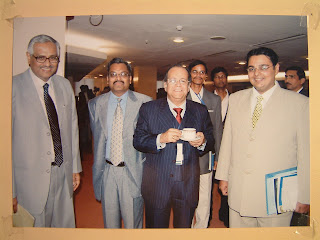
Suchitt Dave with Supreme Court Judge Justice RV Raveendran and Orissa High Court Chief Justice AK Ganguli

Well, that is what most lawyers think – particularly in India. They say if you complicate the system, you don’t bring an end to the litigation, it keeps giving you milk like a cow. Well that analogy may certainly hold true, if you are living in an era of shepherds. However, when you are stepping in a world of “service industry”, you are talking about production, productivity, efficiency and profit maximization. You do not talk about benefiting from delays but you talk about giving least time to a case and earn maximum out of it. So you want to be faster. You want to make sure that your case turnover is really-really very high.

To do this, a seminar on was recently conducted by the Confederation of Indian Bar. The President of India inaugurated. The Chief Justice of India Chaired the occasion and various participants included Judges of Supreme Court of India, Judges of High Courts, Attorney General of India, Solicitor General of India and lawyers of Supreme Court of India with lot of other lawyers participating from world over.

I had been a speaker on this Seminar to talk about Speeding up Justice Delivery System with special reference to Procedural Reforms and Use of Technology in Case Management.

Well, I looked over at the topic, thought if this could be a great thing to discuss. The topic has myriad of colors. Use of technology can do lot of things. It can simply bring all the papers from trial court to High Court or Supreme Court at a click of a button. It can bring you all the references in a blink of an eye. It can make your forensic much stronger. It can make you work at home, eat an ice-cream and contest your case from the court. It can monitor the trial court judges. It can measure their performance, their consistency in case decisions. The productivity can be gauged and there are so many things that can be done with the use of technology in case management.

Not that was a bit too simple. Well, let us churn the topic a bit to get the cream. We know what we can get, but there are so many moot questions to be decided and perhaps answered more strictly technically. So that is what we did with use of technology in case management. I spoke on the subjects giving various examples. Here is the brief review of the white paper that I presented on the occasion. Shortly the photographs of the occasion will be published.


Suchitt Dave, giving his speech at the Confederation of Indian Bar Seminar on Judicial Reforms at Vigyan Bhavan

Brief Overview:
“Case Management” becomes an important job-activity in legal arena when we got to wade across huge paper work in a time-bound program. The benefits that the user must get by technology for case management are: Enhanced Flexibility, increase in productivity, improving client (litigant) services, optimizing profits & reducing costs.

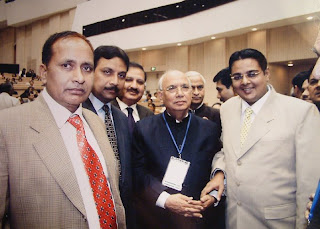
President of India Pratibha Patil, Chief Justice KG Balakrishnan, Law Minister Hans Raj Bharadwaj, Supreme Court Bar President Pravin Parekh and others seen at the Seminar


This can indeed be achieved if the technology can define workflows to meet specific requirements, specify procedures including automatic updates of key dates and reminders to lawyer diaries, create screen layouts for the input and display information, design document in word processing system, process multiple task simultaneously on a single matter and electronically store documents with easy and precise retrieval capacity.


Purpose:

The purpose of this paper is to present technology in case management from both the perspective: Courts and Lawyers. Case management becomes important to both the courts and lawyers. Use of technology can do much to resolve myriad of legal issues.


Discussion:

Case management refers to control of the movement of cases through a court, or a method of managing cases within the litigation process. Lawyers generally need case management software to effectively manage their caseloads.

With reference to a court, it is a sort of court process that allows a judge to monitor and manage the progress of a court case as it moves through the system. As part of international practice, it includes a process by which litigants have an opportunity to meet with a judge / jury to try and resolve their issues together.

The basic goals of any case management from court’s point of view are:

 to reduce unnecessary delay in reaching a final determination of a case
 to reduce the costs of those involved in the case
 to encourage people involved litigation to have a direct part in finding mutually satisfactory solutions
Suchitt Dave with Law Minister Hans Raj Bharadwaj


What does Case Management Software – CMS do for me as a lawyer?

Essentially, case management software consists of a database that is designed for lawyers and law firm staff to easily use to manage all of your office information. It should either replace or be used to generate many of the paper tracking systems you now utilize.

In an ideal world, CMS would encompass all of the information you use in your office and help you perform all of your daily tasks. You should look to your computer to determine anything you need to know about a case instead of looking to the paper file for one bit of information, the card file on your desk for another and your pocket calendar for a different one. Why wouldn’t any of us wish to embark on this road if the end result is one piece of software that does everything for us?

It is true that implementation of a CMS product is not an easy road. You have to carefully shop for the features you want. Then you have to integrate it with other systems. Then you have to train everyone on how to use it.

That’s okay. But does it mean using technology for mere calendaring which case is when? No. We don’t want a software that merely shows us the case timetables. We want to go beyond that. What sort of technology, do we than use?

PREREQUISITES OF A CMS (CASE MANAGEMENT SYSTEM):

Well some prerequisites of a case management technology should be:

COST:

Cost is not a problem if the MIS system is to be installed for a court. However, when we are in a country like India where budget allocation and resources are scarce, cost becomes important. From lawyer’s point of view, cost is important. Ideally, you want to find a program that is "scalable." This means that the software is technically equipped to grow (or shrink) with your office, and is priced according to the number of users.

Suchitt Dave with Justice CK Thakkar - Judge Supreme Court of India

SHOULD NOT BE A GLORIFIED CALENDAR MANAGER:

True case management programs offer calendaring/docketing functions as well as document management. These more sophisticated programs allow you to file all your case documents and search for them when needed. You should also look for document assembly functions, image scanning, and image storage. You should be able to organize your case details, parties, documents, discovery, exhibits, research, data, phone calls, e-mails, postal mail, dockets, appointments and your tasks. You can even recycle research and other case elements using past cases and case templates.

EASE OF USE:

Most of us are lawyers -- not programmers -- so it is essential that your case management system is easy to use for lawyers. The most intuitive systems feature tabs that mirror a lawyer's file cabinet with tabs for depositions, discovery, summons, pleadings & motions, etc.

CASE COLLATERALS:

Beyond document management, your case management program also should manage case "collateral," such as photographs, exhibits, doctor bills, etc. This allows you to scan the collateral item and label it. When you need to access it, you simply open the image.

CUSTOMIZABLE:

Lawyers, depending on the nature of their practices, need to keep track of different kinds of information. Look for the ability to customize the program. For example: if your law firm frequently uses a particular document template (i.e. Request for Medical Records), be sure the case management software includes templates for document assembly and allows you to create additional templates.

E-MAIL TRACKER:

Many programs allow you to create and send e-mail; however, most do not file the originating message. (Once it's sent, your record of the message disappears.) Therefore, you want to look for a program that files e-mail messages with the case correspondence. Some programs automatically file the response to the e-mail as well.

PORTABILITY:

More flexible case management programs include a "pack-and-go" feature that allows you to copy your case data (including exhibits) onto a CD or onto the hard drive of your laptop.

Then, while you're out and about, you can access relevant case information (without carrying around boxes of files) and even make changes and additions. Once you're back in the office or hooked up to the Internet, you can integrate (synchronize) changes and additions into the case files.

COMPATIBILITY:

I think this one is the most important of all the features. For instance, the software should be compatible to accounting software and even to word processor. For example: Let us wonder why law firms were early adaptors of computers? Word processing, of course. We take the present for granted now, but in years past legal secretaries used to spend a lot of time retyping pages that had already been typed to make a change or add something new. Whether you are a true believer in Microsoft Word or Corel WordPerfect, you have to agree that the latest word processing software packages are powerful tools. No CMS company would hope to duplicate a word processing program starting from scratch. These products have been refined and improved over many years.

So, one aspect of good case management software is that it has to interact with your word processor, for example, the name and address information from your CMS and import it into the letter to the client.

Similarly, the CMS should be compatible with say an accounting program and should be capable of importing and exporting data from a program to another.

TECHNICAL SUPPORT:

If you have ever run into problems with computer software, you know the importance of good, competent technical support. When it comes to case management, you also need to take training into consideration. "Out-of-the-box" programs may not offer any training. They leave the learning process up to you or your MIS department. For programs that offer on-site training along with the installation of the software, make sure the training is provided by the manufacturer, not a contracted consultant. There have been more than a few instances where contracted consultants or vendors have "made a mess" of an installation.

Now let us see the uses of CMS using computers, once it is installed:


Suchitt Dave being presented with a bouquet of flowers at Confederation of Indian Bar

USES OF CMS:

Rolodex

“Rolodex” in western parlance is a sort of folder that contains the name, address, phone, and other pertinent information of key contacts. Rolodexes include clients, interested parties, other lawyers, judges, and just about everyone else with which the lawyer / law firm has had contact. Well, that's the first major CMS function – the Rolodex. All the constituents of firm are hooked by a password with the CMS. The moment there is a change in Rolodex, it is available to everybody in the firm. No more looking in the paper file (that is, if you can even find the file) to find the client's phone number.

Case/Matter Database:

The next CMS function is to "open" the case or matter. Understanding how a new matter is created is key to understanding information flow in the firm / law department. In law firms / law departments, various pieces of the case information pass through many hands - in different formats e.g. paper form, handwritten or typed information, multiple documents and forms, papers presented at trial court, appellate court, court of revision etc. All these form a part of case data base. This will be important information about a case, list of witnesses, their statements, opposing counsels etc. All this information is right there on the paper but not in the computer. You have same paper being present in multiple places resulting duplications and cropping inefficiencies. The central case data base avoids all this.

Case Calendar

Next on the list of CMS functions is the calendar system. All the law firms maintain a case diary at trial court levels. High Court or Supreme Court provide for individual lawyer cause list. Well but they do not provide who is to file what? What is to be done next? Microsoft OutLook and Novell GroupWise provide for these facilities. But they are not CMS by themselves. So the CMS should be able to provide for the calendaring facility as well. What if you could "assign" a list of critical dates to one key date? For example, a trial date is set. All you do is schedule the trial date and time and a list of ticklers, deadlines, and appointments are automatically calendared for you. If the trial date changes, you simply change the key date and all assigned ticklers are automatically changed with it, taking into account holidays and weekends. This is called "rules-based" calendaring and is a part of many of the case management systems.

Does this mean you have to enter the same appointments and ticklers in OutLook or GroupWise as well as the CMS calendar? No; case management systems integrate with OutLook and GroupWise and merge all data into one system. No more double entry and no more synchronizing multiple calendars by frustrated legal assistants.

Case Diary

The lawyers say so many things in a court case those which are not a matter of record today. It is a matter of memory of the judge and the opposing party lawyer. How if we could simply encapsulate all this information in one go. Say a lawyer says – “I assure you that I will file my counter within a week. My steno was sick and I could not get the dictation to present the memo to the court” (In a case where counter affidavit has not been filed since 6 months). This becomes a part of case diary and the dictating machine records these words into the CMS like this:

“Court Name:__________
Court no. 4
Item no. 9.
Date: DD-MM-YYYY: Time: 12.22 p.m.
Mr. X Versus Mr. Y.

Advocate Shah – “I assure you that I will file my counter within a week. My steno was sick and I could not get the dictation to present the memo to the court”

Judge – “And you are granted this adjournment on your assurance that you will not seek any further time. Your client has already taken 6 months”.

Advocate Joshi – “Your Honor! I hope this is the last chance or else we close his right to file a counter”.

They do not form part of case records, but a sort of case diary monitoring the conduct of parties during the case. Yes, this makes every word concerning case, recordable and we make everybody responsible for what they say or did during the case.

The case diary is a key component in a case management system. This function will be used by the attorney more than any other feature because it becomes the center for case information and communications. This will constantly push up a lawyer to finish his work in time and meet with deadlines rather than failing them.

Document Generation

Just think of all those events that take place in a case. We start from trial court. In a civil case, for instance, a suit is instituted, written statement filed, counter affidavit, list of witnesses, list of exhibits (documents admitted to evidence), list of documents not admitted, statements by experts, witnesses, plaintiff, defendant etc. This is than supplemented by various papers those are created during appeals, revisions, reviews and other rounds of litigations. What if we could simply connect them with hyperlinks? Click to one document and get another. Read into the documents and relate all documents giving same message in one group. Another set of documents, not a part of litigation into another folder of the central data base & so on. Document Review process and concept searching - all in one place giving out all relevant documents at a push of a button. Same set of documents available to all the parties and to the court from same data-base.

The CMS is automatically integrated with your word processor and you need to enter data once that is updated as and when entered. CMS must provide you with one more advantage i.e. tiff-ing the paper document to images that can be altered and redacted into the CMS. We will discuss (1). Document and concept search method and (2). Tiff-ing technology later on.

You can see that by using a CMS, the legal profession can change from a "word processing-centric" environment to a "case management-centric" environment. That is, the case management system is the main system on the computer desktop - not the word processor. Everything happens from within the case management system.

Summary of CMS technology Uses:

Those are the five basic functions of computerized case management systems: rolodex, case/matter database, calendar, case diary, document generation. There are, of course, other functions that are part of the system. These include standard and customized reporting, interfaces with groupware applications and laptop synchronization to name a few. All of these various functions, and how your firm / law department / court will use them, will help you determine which system is right for your concerned entity.
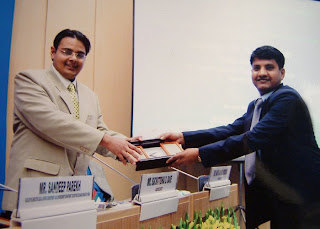
Suchitt Dave being Presented with a momentous as an Honour to him at the Confederation of Indian Bar's All India Seminar

CMS Assessment – What is the transition

Big question is how to implement case management is the transition from law firm’s / law department’s or court’s current procedures to the new system. There will always be a big transition, but it helps to understand how we are handling matters now. Consultants call this a "workflow analysis."

Trial court lawyers work on a particular case. They create a list of documents. They present their pleadings, take statements, argue their case, put up points of facts, points of law. In doing these activities they follow procedure prescribed by law i.e. either CPC or Cr.P.C. The questions those come to appellate courts / courts of revision or writs are: (1). Points of law; (2). Correctness of adjudication regarding points of facts & (3). Whether ratio has been consistently followed?

While presenting case to the courts they say lot of things those are informal. They have no bearing on the merits of the case, but certainly are important in understanding the conduct of parties during case right from inception to the end.

The above generally forms a work-flow analysis of any litigation. We now got to convert the paper documents to electronic documents and segregate the documents according to their messages they convey. We do this by Concept search and tiff[ing] technology.

Now by doing above, we created a CMS that has everything from Rolodex to Central data base. Now you simply give out the document references in a case and finish off your matter in shortest possible time without duplication of energy and time from one lawyer to another. What you are doing is simply log on to the Case Management System and put the system to work.

Tiff-[ing] technology

TIFF means – Tagged Image File Format. What’s that? TIFF image is simply "a digital photograph of a document." This technology is becoming a standard practice in legal industry. To be fair, TIFF imaging can be complex ¬ but a little planning and knowledge at the outset can make it a smooth, efficient and cost-effective process.

It's important to know that the primary benefits of TIFF imaging include immediate access to documents, the elimination of mis-filings, and the reduction of storage, copy and file maintenance costs. If you have a clear picture of what to expect ¬ and what not to expect ¬ you'll be more likely to gain new efficiencies without the frustration of unattained goals.

Admissibility

Necessary legislative changes ought to be ushered in to ensure that TIFF images are admissible in court. Once a TIFF image is scanned, it cannot be changed – so it should be easy to make and produce tiff images as admissible in the court.

Cost

Another common concern is cost. How expensive is imaging?

Imaging is not very expensive. Moreover, once the document is imaged, you can print it less expensively than making a second set of copies. And the storage costs are significantly less. Consider 10,000 pieces of paper on one CD-ROM, compared to those same pages stored in four boxes.

Once your firm has decided to embrace TIFF imaging ¬ or even if your firm has been using it for years -- it may help to ask yourselves a series of fundamental questions in order to better evaluate what imaging can do for you.

Tiff[ing] V/s. PDF

If some tech-guy reading this paper advocates PDF over Tiff, I have no problem with that. I doubt if lawyers will care about the formats - .pdf [or] .tif. What-ever it is, both have some advantages over the other. With use of Acrobat Pro – tif gets converted to pdf. For the purpose of this paper I have rather used tiff[ing] technology being the largest repository of documents world-wide. I won’t get into those details right now being out of the purview of this paper.

Wading documents by using “Concept Search”

Concept Searching allows you to retrieve documents based on concepts.
For example, a search for "GPS" would also automatically retrieve documents containing the phrase "Global Positioning System". This works both ways, a search for "Global Positioning System" would also find documents containing only "GPS".
The concept search can be a powerful tool in that the concept itself can be a boolean expression. E.g., Intel used the name of a River as the development name for it's 64 bit microprocessor chip, Merced. You could define a concept, "Merced" so that any time you searched for Merced, you are really searching for "Merced and not Merced River".

Concept searches solve the term mismatch problem in the sense that a concept search will return documents that relate to the same concept as the query word, irrespective of the specific word chosen by the user and the specific words in the documents. At the same time, concept searches contribute to the other fundamental goal of information retrieval systems: increasing coverage.

By returning all documents that relate to the same concept, a concept search tremendously decreases the risk of missing important documents that do not contain the exact word selected by the user but pertain to the same topic.

Two techniques can be used to perform concept searches:

Manual Techniques:

These techniques use customized thesauri and semantic networks. When a user types in a word, the system can automatically include in the query other words that belong to the same node of the semantic network. The main drawbacks of these techniques are the high cost of building, adapting, and maintaining those thesauri through human intervention and high language dependency. On the other hand, these techniques offer considerable customization and personalization capabilities.

Mathematical Models/Machine Learning Techniques.

These techniques use latent semantic indexing, Bayesian methods, and neural networks-based context vectors. These fully automated methods try to discover inherent underlying associations among words extracted from the data collection, building a query interpretation model. This model acts like a "black box" containing internal associations. The learned model is used to facilitate fuzzy searching on the resulting patterns. The main issue associated with these techniques is the lack of transparency and lack of user control over the query and results. When users obtain a result set that they find inadequate, they are left with no explanation of the inadequacy or way to improve the query or result set. Their only option is to enter another query, hoping the next trial will yield more relevant documents.

Additionally, these techniques tend to "overfit" the data, expanding queries to more generic concepts to the detriment of precision in favor of better recall.

Concept search will enable the judges and lawyers get machines do their job in arranging the documents according to their responsiveness – the entire fruits of CMS are enjoyed when the mechanism is built up.

Is Your Firm / law department / court a candidate for a CMS?

I think every law department, every firm and every lawyer should be a part of CMS offering above uses and following the pre-requisites.

There are dozens of computerized case management systems available for the legal profession. They range from general CMS systems that work in most practice areas to those specifically designed for a particular practice area. You'll find more general purpose CMS systems that can be customized that for specific systems.

For firms with multiple departments, most CMSs are customizable, meaning you can uses the same CMS, but customize the data screens, the "rules-based" calendar, the document merge, and the reporting for each department. It does take some planning effort on the part of the law firm, but having a single database in the firm is a big plus and a huge move toward increasing productivity and decreasing inefficiencies.

Success Tips for Implementing CMS

There are plenty of success stories of firms implementing CMS systems. There are also plenty of failures. The law-firm / law department reluctance to the implementation of CMS boils down to three things:

1. The Cost of CMS.

This doesn't just mean the purchase price of the CMS. You've got to include the downtime and unbillable time of the firm during the transition. Automating case management in a law firm is an intangible asset. Sure, we can touch it and feel it, but can we use it and get a return on our investment. This factor isn’t very important when it comes to courts implementing CMS.

2. Unfamiliar Territory.

Face it, lawyers are so busy they get into a routine of what needs to be done in a case and how it gets done. When you start talking about case management, you step outside that "comfort zone," something we are all very cautious about.

3. Education and Training.

This is really every-body’s job. It is important to understand the benefits of case management, and helping them to understand this will change the way we practice law to-day.

Some important tips in implementation of CMS are:

1. Case management systems are not an overnight implementation. They take time and careful planning. Very few lawyers / law department / law firms are geared for buying the software, installing it, customizing it, and learning it on their own. Depending on the CMS system, we should realistically expect a six-month to one year implementation schedule. The things that drive this time frame are: amount of customization, amount of training, and the amount of data conversion or data migration from existing case and matter information.

2. We need to have a project manager in the firm to coordinate the installation and implementation, if it’s a big firm. For smaller firms, support should come from the vendor. Lawyers and firms have to take on to this task along with the courts. This person has a lot of responsibility and, with proper planning, should be able to coordinate all efforts. This person may also have the savvy to do the customization. This should be a full-time job for the initial implementation. In other words, it needs to be a priority and this person needs a lot of support from upper level management. If it’s a vendor support, management of law-firm / solo lawyer should provide with all possible assistance.

3. Know and understand your manual system first. Without performing even a cursory workflow analysis, you cannot know or anticipate what will change when you automate these CMS functions. Document this process, because it will help you understand when you can eventually quit printing needless reams of paper and start relying more on electronic information.

4. Make a commitment from the top. If this is going to be a successful implementation, the managing partner or management committee, the executive director or the legal administrator, and the technology partner or technology committee must make this a priority. Otherwise, those involved in using the system will undoubtedly find ways not to use it.

5. Know the attorneys and staff will be going through a mental transition. You've been practicing law for many years doing the same thing the same way. Lighten up a little bit for a couple of months, helping to understand the changes people go through. Continuously communicate and "lead" the firm through the change.

Training – Key to Successful implementation of tech-savvy CMS:

We often tend to put training at the bottom of the list of investments. Law firms / law department have to train their men because that part grooms the investment put to hardware and software technology. Senior Lawyers particularly need training in their transition from paper to no-paper office.

Firms that are successful in their implementation of computerized case management take full advantage of training and the support of the developer. It's no coincidence that training increases law firm productivity. But, it has to be top-down. That is, the firm's management and administration must commit to training. Everyone using the system will benefit from training, even if it's just an overview.

Real life story:

Let me tell you a real story: Once upon a time, there was a law firm. One of the attorneys was very computer literate and pushed the firm toward improving client services with technology. The senior partner, who was not computer literate, fought tooth and nail against spending any money on these "toys." But, he was voted down. However, he refused to have a computer in his office. He backed off that, too, because the other partners convinced him the staff morale would drop if everyone did not "buy in" to the new system.

The first day back from training, the attorneys and staff were instructed to send emails to each other in order to get used to the new system. Well, the technology partner sent the senior partner an email. The senior partner took out his yellow pad, wrote an "answer" on the pad. He ripped off the sheet, walked over to the technology partner and taped the paper to the monitor. He wanted to "make a statement."

Several days later, the senior partner's secretary, who'd been with him for fifteen years, walked in and closed the door. This patient lady knew he was frustrated and wanted to help. She slowly explained the benefits of email. In this case, the senior partner's daughter was going to an out of state college. "You mean I can be working here in the morning and get an email from my daughter?" "Yes," was the quiet reply. "How much does that cost?" "Nothing. It's part of our system." "You mean I can send my daughter an email in the afternoon and she'll get it that night?" "Actually, she'll get it within a few minutes of you sending it." "And how much does that cost?" "Nothing. It's part of our system."

Well, needless to say, the senior partner figured out that email rocks and he was going to learn it, no matter what. In addition, I heard later that this senior partner, who had fought the technology project from the beginning, was now as computer literate, if not more, than the technology partner. All it had taken was a patient person to help him gently step outside his comfort zone. In most cases, that's what it takes, just a little understanding and a little help.

The Future of Computerized CMS

Case management has come a long way since the first clunky DOS-based systems. Along with other graphical-based systems, case management technology has kept up with the times.

Wireless is what most everyone is talking about. Remote computing, combined with wireless technologies allow the individual attorney to be in a virtual office. That is, you can be roaming anywhere and have instant access to your full case management system, either remotely or in the palm of your hand. Many CMS developers now-a-days offer remote access through the Internet. Most also provide laptop download and synchronization and most download information to the Palm.

There are more developers seeking business relationships with other market leaders in other business segments. For example, a CMS developer may not have a document management system, so the company is striking up a relationship with a document management system developer. Another example may be the CMS developer wants to partner with several time & billing systems, so they partner up with the industry leaders. While these relationships have been around for a while, we're starting to see a much better and greatly improved electronic interface. What does this mean to your firm? Faster, better case management system, less time devoted to individual case and more of productivity and per case returns. What does that mean for the court – of course a fine disposal rate with genuine attention being paid to all the cases – not sort of “Lok Adalats”.

Colorado State – Case Study:


Implementation of CMS at Court levels - PPP Approach vis-à-vis e-filing:


There are three alternatives to implement CMS at the court level. First is develop indigenously, second, buy off the shelf and third enter into a Public Private Partnership. It is important to state that when we talk of CMS from court’s angle, we cannot forget that CMS is a comprehensive system that must connect the law firms / solo lawyers / law departments and non-law users with the courts. Let us understand what SCAO – Colorado State Court Administrator’s Office did to resolve same problem it faced a decade back.

Decision to Build, Buy or Partner

One of the earliest issues the SCAO addressed was how to develop a statewide e-filing solution. Three major alternatives were considered: build internally, buy off-the-shelf software, or create a public-private partnership. Ultimately, the SCAO chose a public-private- partnership with LexisNexis.

Considerations for Building an E-Filing System

The SCAO concluded that building a system from the ground up would take an enormous amount of time and resources. The SCAO findings also conveyed the importance of accommodating non-court users in the legal community demonstrating that the needs of law firms were extremely important. The level of technology and scope of functionality required to develop an e-filing system was projected to be substantial. Document management, integration, security, linking of documents and data management were just some of the critical functionality considered.

Furthermore, if an internal system was developed, the State would have to fund and manage activities for training users, providing ongoing customer support, marketing e-filing to the legal community, and maintaining the system.

Buying Off-The-Shelf E-filing Systems

A second alternative for the State was to purchase an off-the-shelf solution. At the time and still today, there are few if any true off-the-shelf options for purchasing an e-filing application. The most viable option comes in the form of case management systems that include e-filing capabilities. But in addition to the substantial cost and lengthy implementation of such a solution, most case management systems include only rudimentary e-filing functionality, and little if any capabilities for law firms to effectuate service.

A Winning Combination: Public-Private Partnerships

The PPP approach was taken by the Colorado State Court Administrator’s office (SCAO). In 1995, the SCAO faced a challenging dilemma—how to deal with the increasing avalanche of paper created by a growing civil litigation caseload. The SCAO looked to a relatively new technology as a method of improving court operations—electronic filing of court documents.

The SCAO selected LexisNexis® File & Serve; successfully implemented e-filing across a variety of case types including all general civil, probate, domestic relations, and water courts.

Working with LexisNexis® in a public-private partnership, the State of Colorado demonstrated that e-filing can be implemented effectively and at relatively little cost to the court or clerk’s office.

A public-private partnership had none of the high development costs and lengthy implementation drawbacks of building internally, and offered a better mix of functionality and support activities than a “purchased” solution.

Colorado was able to shift the cost of system development, maintenance, and upgrade to private partner and away from valuable public resources. Private partner on the other hand, is able to spread the cost across many other jurisdictions while maintaining a constant flow of investment in developing system improvements— something a court is typically not equipped to do.

LexisNexis provides the service over the Internet rather than as a software application. Attorneys are able to easily file and serve documents over an Internet connection after installation of necessary CMS functionality. Meanwhile, the court gets an e-filing system that provides the ability to review incoming documents, the functionality for judges to issue orders online, and integration with the case management system—all at virtually no charge to the court. System costs are recovered through fees attorneys pay for documents filed with the court or served to other parties.

More than seventy courts across the state judicial system implemented e-filing and, according to the Colorado Supreme Court, the project was so successful that e-filing was used in over 80 percent of the district court civil cases on completion of the project.

Colorado has realized several key advantages of a public-private partnership with LexisNexis.

• No significant capital outlay required to develop the LexisNexis e-filing system

• Rapid implementation compared to other court technology projects

• LexisNexis makes continual enhancements to the system

• LexisNexis drives adoption in the legal community

With e-filing, judges access case documents in seconds and view and respond to motions online. Clerks receive, process, and retrieve documents in minutes rather than hours or days. And e-filing enables law firms to have substantially more direct control over their case file management by improving access to case information, automating case monitoring, and eliminating delivery.

LexisNexis File & Serve is integrated with the Colorado case management system and data is securely and efficiently exchanged between the two systems. This has resulted in a much more efficient intake process and has eliminated unnecessary data entry.

What we need is to allow specialists do their jobs instead developing technology products indigenously. Can we do it? Well that depends on the will of the “top”.

E-filing and CMS:

When we talk of CMS we include within that – a technology interface that eliminates papers, brings down duplication of efforts and increases productivity.

E-filing is the first step to-wards the successful implementation of CMS. If you can convert all the data to electronic form right from the point of entry, you save a lot of time you got to spend on converting existing papers to e-formats.

It is important that E-filing is introduced at the trial courts. They are points where a lot of paper documents are generated. They simply create a clutter in the entire system of workflow. For successful implementation of E-filing, the resistance levels of lawyers needs to be brought down and we got to get out of our comfort zone.

Overcoming Challenges

While the project has been a tremendous success to date, there have been challenges. Two of the biggest hurdles relate to the need for change management, and the investment in infrastructure upgrade.

The introduction of e-filing technology throughout the judicial system has impacted roles and responsibilities, streamlined workflow, and changed the nature of day-to-day interaction with the legal community. While LexisNexis File & Serve generally mirrors existing processes, there are significant differences at the intake counter and in the process for taking judicial action.

Beyond the cultural change that is required for a court to fully implement e-filing, there are infrastructure costs that may be incurred as well. These costs however, are not unique to an e-filing initiative. High-speed access to the Internet, a robust network, and an adequate number of computers are critical to a successful project. While there are no usage charges to the court for LexisNexis File & Serve, there may be costs for technology upgrades if the infrastructure requires updating, as was the case in Colorado. These infrastructure enhancements are of course likely to provide a shared benefit in an age where many court services are provided over the Internet or an internal network.

A View from the Bench

More than 1,000 Colorado judicial officers and other court users have been registered in LexisNexis File & Serve since the e-filing project went live. At any one time there are several hundred users actively using the system and realizing the benefits of what is virtually immediate access to case documents and other information. Key reasons for the increased usage include:

• No longer forced to wait for documents to be copied or retrieved from some file box buried in
the basement, judges and law clerks can search for and review thousands of motions, pleadings, exhibits and other case documents in seconds.

• No more lost or missing files.

• No more delay while filings sit in the intake queue.

Additionally, once motions are reviewed, judges are able to issue signed orders online, resulting in an even higher level of responsiveness to litigants. Key stakeholders including judges, clerks, attorneys and others who all need the same case file information can access an electronic document. The electronic filing of documents allow them to have access at anytime without the wait associated with sharing a single paper document.

An Integrated Solution

Integration with the court’s systems was a critical factor in selecting an e-filing solution. While LexisNexis File & Serve offers several options of integration with court systems, Colorado chose a fully integrated approach with their ICON case management system.

Transactions and case information are exchanged in real-time between the two systems, substantially reducing data entry activity and improving data accuracy and availability.

Alternative vendor solutions reviewed by the SCAO did not have integration options or only provided superficial or batch approaches to integration. The two-way integration between LexisNexis File & Serve and the ICON system supports the SCAO’s overall objective to create a fully integrated judicial system.

Embraced by the Legal Community

The most powerful demonstration of the success of e-filing is the level of adoption among the legal community. Even in a voluntary environment, Colorado law firms have increased their usage of LexisNexis File & Serve—some even instituting firm-wide practice standards that require electronic filing and service.

Colorado courts are receiving an average of 15,000 electronically submitted filings per week.

Today, nearly one and a half million documents are now electronically filed and served annually in the state. Thousands of law firms and eight thousand attorneys have incorporated electronic filing and service as a practice management standard.

Benefits to Law Firm:

Law firms are realizing the direct benefit of greater control over case file management with e-filing and e-service. The law firms:

• Gain improved access to case information

• Increase efficiencies through automated case monitoring

• Effectively eliminate the physical logistics of delivering documents to the court and opposing
Counsel

Additional benefits include increased cost savings. The cost of e-filing and e-service with for Colorado law firms is a fraction of the cost of paper-based filing and service—ultimately reducing the overall cost of litigation.

E-filing has become so widespread that many individual Colorado courts are now converting from voluntary to mandatory e-filing. A fully mandatory environment greatly reduces the burden on the clerk’s office—eliminating the need for double docket entry (online and off-line) and provides greater consistency for the legal community. Colorado’s county courts are in the process of joining the project and will be implemented under mandatory rules.